IFRS 18 takes effect on January 1, 2027. Are you ready?
IFRS 18 replaces IAS 1 and transforms the presentation of your financial statements. Anticipate the impacts on your income statement, your MPMs and your consolidation systems.
2027
What changes with IFRS 18
New income statement format
Five mandatory categories now structure the P&L: operating, investing, financing, income taxes, discontinued operations. Your chart of accounts, income statement structure and consolidation mappings must be realigned.
Management-defined performance measures (MPMs)
Any subtotal not defined by IFRS (adjusted EBITDA, recurring profit, adjusted operating profit, etc.) becomes an MPM: it must be defined, explained and reconciled to a comparable IFRS subtotal, in a dedicated note now subject to audit.
Consolidated-management bridge
MPMs must reflect the performance communicated by management, with an explicit reconciliation to IFRS aggregates. The link between consolidated financial statements and management reporting must be formalised, and your tools must produce it in a reliable, repeatable way.
Enhanced notes and disclosures
A single note brings together all MPMs, with reconciliation, tax effect and non-controlling interests effect line by line. Where expenses are presented by function in the P&L, a note by nature becomes mandatory. The “Other” label is now restricted, except for immaterial items.
Restructured statement of cash flows
The starting point of the indirect method moves to IFRS 18 operating profit. Interest and dividends paid migrate to financing activities. For many groups, reported operating cash flow changes in amount without any actual cash flow moving.
IFRS 18 white paper
Impacts, timeline, watch points and action plan for finance teams. The transition guide we hand to our clients.
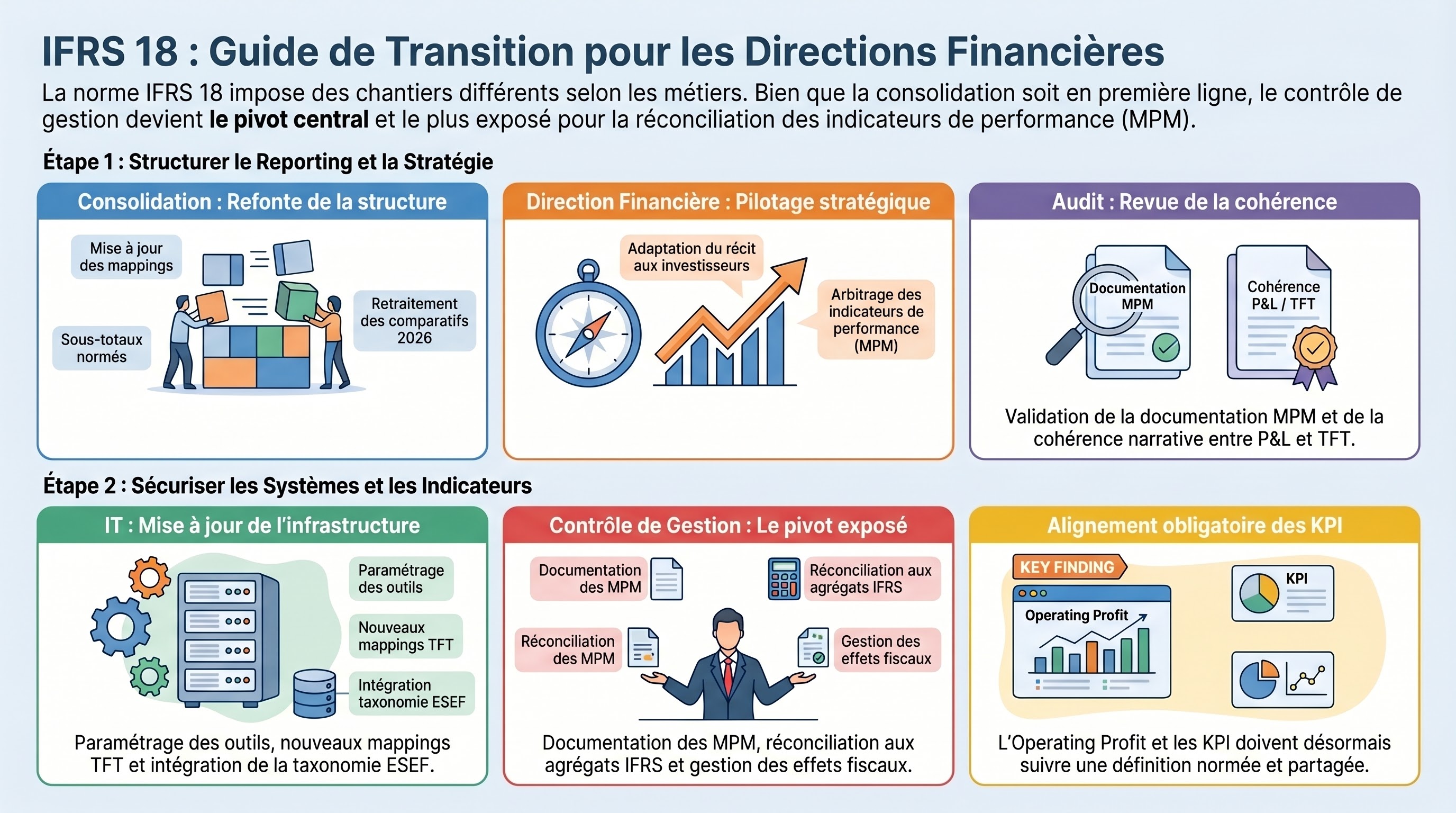
Our method: diagnostic first, then execution
Four steps, with deliverables that finance teams and auditors can put to work immediately.
IFRS 18 diagnostic
Mapping of your financial statements, identification of IFRS 18 impacts (income statement, performance measures, notes, systems) and assessment of your ability to produce the IAS 1 → IFRS 18 reconciliation on comparatives.
Deliverable: impact report + prioritised roadmapTechnical preparation
Realignment of the chart of accounts and mappings, scoping and documentation of MPMs, construction of the consolidated-management bridge and definition of the new note structure. Tool configuration recommendations where needed.
Deliverable: mock-up of the new financial statements + IFRS 18 documentation fileDry run and audit assurance
Parallel production of old and new formats on one closing, with IAS 1 → IFRS 18 reconciliation and MPM disclosures, working with your auditors to secure presentations, aggregates and key judgements.
Deliverable: auditable IFRS 18 financial statements + auditor engagement packAdoption and training
Skills transfer by audience: consolidation, controlling and FP&A, financial communication. Each module includes a hands-on case study on your own data.
Deliverable: training materials by audience + internal reference guideFrequently asked questions about IFRS 18
Answers to the questions most often raised by finance teams.
No. IFRS 18 changes the presentation and structuring of the income statement (categories, subtotals, notes), not the measurement of net profit. Net profit remains identical: it is the intermediate aggregates and the way they are read that change.
An MPM (management-defined performance measure) is a performance subtotal that you communicate and that is not defined by IFRS: adjusted EBITDA, recurring profit, adjusted operating profit, etc. If you publish this type of indicator, IFRS 18 concerns you: it will have to be defined, explained and reconciled in a dedicated, audited note.
Yes. The new presentation and disclosure requirements, particularly on MPMs, extend to interim statements prepared under IAS 34. Preparation must therefore cover your half-year closings, not just the annual report.
Consolidation mappings and configurations must produce the new categories and subtotals. The statement of cash flows changes its starting point (IFRS 18 operating profit) and the classification of certain flows (interest, dividends paid) shifts. Your tools must be able to generate these formats reliably and repeatably.
Now. First application in 2027 requires comparatives: you must be able to rebuild the prior year in the new format. A diagnostic as early as 2026 leaves time to scope MPMs, adjust systems and secure options with your auditors.
Yes, early application is permitted, subject to the required disclosures. It can be a communication lever for groups that are ready, but it assumes that MPMs, notes and systems are already aligned and audited.
Ready to get ahead of IFRS 18?
Download our white paper or scope your priorities in 30 minutes.